
How to Check for a Warrant in McGregor
McGregor posts no online warrant lookup. No city roster exists either. The warrant check runs through the county court record and two phone numbers, one for business hours and one for everything else. Before calling, gather the citation number, the case number if there is one, the full legal name, and a date of birth. Ask about the warrant type too.
- Call the county communications center at 218-927-7400 and ask which agency handled the McGregor matter.
- Search the citation or case number in Minnesota Court Records Online with the Aitkin county filter.
- Call Aitkin County Court Administration at 218-927-7350 and ask whether a warrant is active and what type it is.
- Ask the McGregor city clerk at 218-768-2717 to identify the notice if the paperwork does not say who issued it.
- Request an existing county service record at 218-927-7433, and speak with an attorney before agreeing to a court date.
How McGregor Warrant Checks Run Through Dispatch
McGregor is one of three Aitkin County cities with its own police department. The county communications center dispatches those officers. That shared desk is why one number reaches a McGregor officer or, when needed, a county deputy. The county dispatch page describes the center as the 24-hour contact for Aitkin County warrants and protection orders. It does not say what a dispatcher will release. Treat the call as routing. Ask which agency holds the matter.
The McGregor Police Department and Municipal Court
McGregor has no municipal court. The Minnesota Judicial Branch gives the Aitkin County District Court original jurisdiction over criminal and traffic cases filed in the county. A McGregor citation becomes a district court case. The police answer for the stop and the citation. The court answers for the case file, the hearing, and any warrant. An officer can explain what the department wrote. Only the court can say if the case produced a warrant.
Where McGregor Ordinance Cases Are Filed
A city ordinance matter and a state traffic charge can look alike on paper. The Aitkin County Attorney prosecutes criminal and traffic cases in district court. That same court holds the McGregor file. The county's one prosecution agreement names the City of Aitkin, so it does not stretch to McGregor. Ask the court which office filed it. The case number is the anchor.
Types of McGregor Warrants
One McGregor case can produce more than one kind of process. The label on a warrant decides what happens next.
| Warrant Type | How It Arises | Who Issues It |
|---|---|---|
| Traffic warrant | An unpaid McGregor citation or a missed traffic date | Aitkin County District Court judge |
| Ordinance warrant | An unresolved city code matter | Aitkin County District Court judge |
| Failure-to-appear warrant | A missed court setting in a county case | Aitkin County District Court judge |
| Sign-and-release warrant | A qualifying first missed date after a mailed summons | The court, with no arrest authority |
| Arrest warrant | A judge-signed order supported by probable cause | Aitkin County District Court judge |
Sign-and-release is the label people mix up most. A qualifying sign-and-release warrant authorizes no arrest and requires no bail. The officer gives notice and a new court date, then releases the person at the scene. Ask the McGregor court which type applies.
How a McGregor Citation Becomes a Warrant
The path from a McGregor citation to a warrant has four steps. An officer writes it and sets a deadline. The court then files the citation, which can take about a week, and assigns a case number. From filing, the driver has 30 days to pay or ask for a court date. If neither happens, a McGregor warrant can follow. Handle the McGregor citation early. A late penalty is separate from a warrant. Minnesota adds $5 after 30 days from case entry and another $25 after the following 30 days, and unpaid amounts can go to collections. None of that is an arrest order. Confirm the McGregor case status with the court. The county traffic warrant page covers the pay-or-lift route and the guilty-plea warning.
No McGregor Warrant Portal Was Located
McGregor publishes no online warrant search. Neither the city nor the county posts a roster, a dedicated warrant line, or a surrender form. The county's most-wanted page is a curated missing-person page, not a warrant list. The jail roster is a custody snapshot. Finding nothing online proves nothing about whether a warrant exists. It shows only what McGregor publishes.
A blank result on any website is not a clearance. Only the issuing court can confirm that a McGregor warrant was recalled or inactivated.
What a McGregor Warrant Record Shows
The case belongs to the district court, so a McGregor warrant record shows the fields any Aitkin County case shows.
| Citation number | The number from the McGregor citation, in the VB form when the case is payable. |
|---|---|
| Case number | The district court file number assigned after the citation is filed. |
| Charge | The traffic, ordinance, or criminal offense at issue in the case. |
| Issuing court | Aitkin County District Court, not a city court. |
| Warrant type | Arrest, failure to appear, sign-and-release, or another label the court uses. |
| Status | Open, payable, scheduled, recalled, or warrant, with the case events. |
The McGregor Clerk and Local Notices
The McGregor clerk keeps the city office at 17 North Maddy Street. The office can explain what a city notice is, whether it came from the city, and how to request an existing record. Staff can also guide a records request. The clerk cannot see the district court file. The clerk cannot recall a warrant either. Certification is the court's job. Send court questions to Court Administration and county service questions to the sheriff's records desk. The county's contact page for McGregor lists the city address, the mailing address, and the clerk phone number.
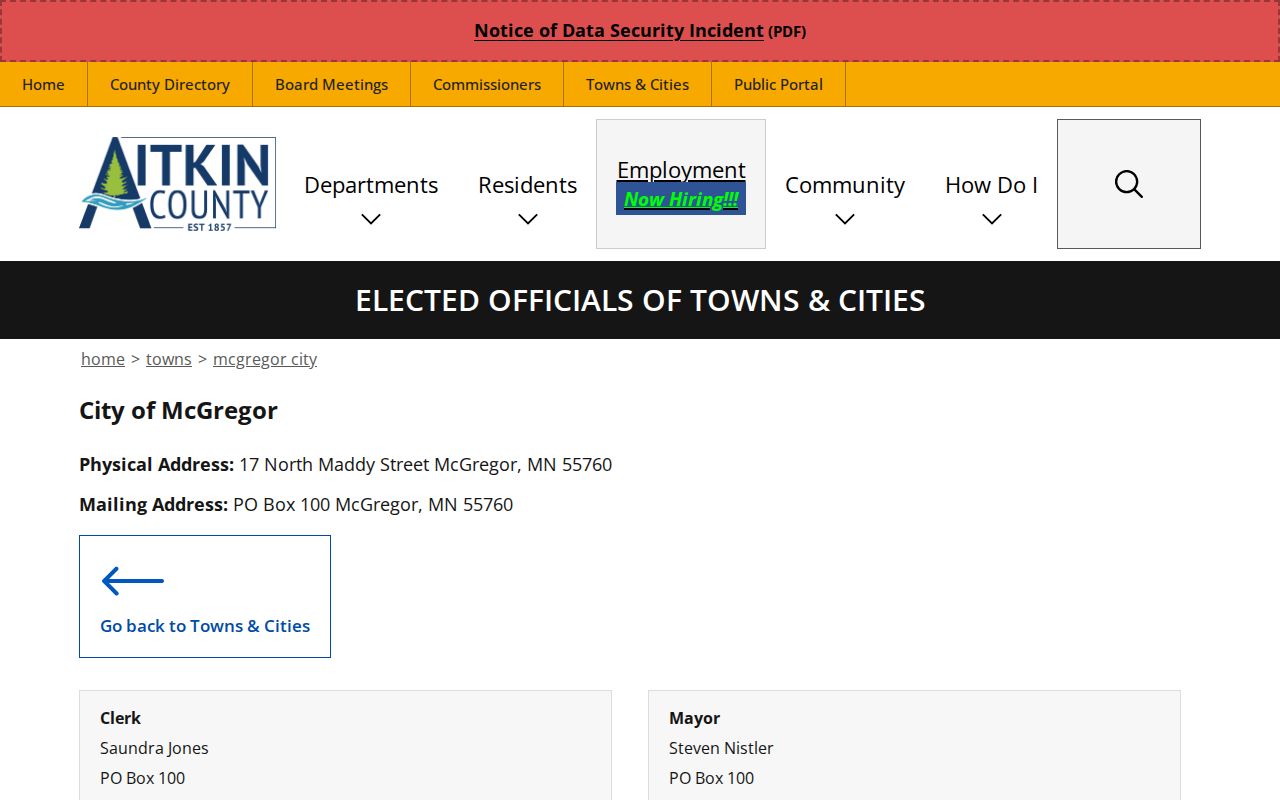
Those are city government contacts. The court and sheriff entries hold the McGregor warrant information.
McGregor Police Records Versus Court Warrant Records
A police report and a court file answer two different questions. The report holds what a McGregor officer saw and wrote at the stop, and the file holds what the court charged, scheduled, and decided. For a warrant status, skip the report. The court confirms the warrant. The sheriff's records desk speaks to service records countywide. Ask at the McGregor police counter and you will likely get a referral to one of those offices.
Note: McGregor's 2020 population of 384 is page context, not a measure of warrant activity.
Where McGregor Warrants Fit With Aitkin County
Every McGregor case runs through the same system as the rest of Aitkin County. The county dispatches the city police. A district judge issues any warrant. The sheriff's office arranges service.
Warrant flow: McGregor citation, district court case, warrant issued by the court, sheriff service, court appearance.
The countywide route, including the other four cities and the state case system, sits on the Aitkin County warrant records home page. McGregor is one piece of it.
Public Access to McGregor Warrant Records
Two rulebooks govern McGregor records. City data follows the state data practices law and city policy. The district court file follows the Minnesota Rules of Public Access. Those rules keep some categories out of remote view.
Key Rules:
The Minnesota Government Data Practices Act, Chapter 13 lets anyone inspect public data without giving a reason.
Minnesota Rules of Public Access control the court record and limit what is available remotely.
Sealed and juvenile material stays out of public view, and an absent name result proves nothing.
Proof to Keep After a McGregor Warrant
Get the answer in writing. A recalled McGregor warrant should leave a court event, a receipt, or a notice behind. A verbal answer fades fast. Note the case number, the office you reached, the date, the warrant type, the next hearing date, and any payment or bond receipt. Check the case again later, because an online record can lag behind the court's own entry. Write down who told you what.