
How to Check for a Warrant in Palisade
Palisade posts no warrant lookup and keeps no roster of its own. The warrant check runs through the county record, so plan on two phone numbers: one for business hours and one for everything else. Gather the citation number first. Bring the case number if one exists, plus the full legal name and date of birth. If the notice is confusing, ask the clerk which office sent it before you call anyone.
- Call the Palisade clerk at 218-838-4455 and ask whether the notice came from the city.
- Search the citation or case number in Minnesota Court Records Online with the Aitkin county filter.
- Call Aitkin County Court Administration at 218-927-7350 and ask whether a warrant is active and what type it is.
- Call the county dispatch center at 218-927-7400 when the court is closed and ask for the current channel.
- Request an existing sheriff record at 218-927-7433, and talk with an attorney before agreeing to any appearance.
Confirming Which Agency Handles a Palisade Warrant
The county's dated planning material lists its city police departments as Aitkin, McGregor, and Hill City. Palisade is not on that list, and the city publishes no current law-enforcement page or warrant channel of its own. That is a gap in what you can verify, not proof that Palisade goes unpoliced. The sheriff's office describes countywide patrol, investigations, criminal warrants, civil process, detention, and 911 dispatch. Until the local arrangement is confirmed, start with the sheriff and the court in Aitkin County. Confirm first, then act.
The Palisade Police Department and Municipal Court
Palisade has no municipal court. The Minnesota Judicial Branch gives the Aitkin County District Court original jurisdiction over criminal and traffic cases filed in the county, so a Palisade citation becomes a district court case. The city also publishes no municipal-court page, payment portal, or warrant-recall form. Skip the hunt for a city warrant window that does not exist. A reader holding a Palisade notice should ask the district court about the case instead.
Aitkin County Sheriff Coverage for Palisade Warrants
The sheriff's office describes service across 1,828 square miles, with patrol and investigation, a civil process and criminal warrants unit, courtroom security, and a county jail. County emergency material says the sheriff's office in Aitkin provides law-enforcement services for the county. That is county coverage, not a city desk. The sheriff contact page lists the main number, the jail, the records desk, and the non-emergency dispatch line. Records staff handle report and data requests. The dispatch center carries the 24-hour warrant and protection-order role.
Types of Palisade Warrants
A Palisade case can end in several kinds of court process, and the label on the paper decides what the reader faces next.
| Warrant Type | What Starts It | Where It Is Handled |
|---|---|---|
| Traffic warrant | An unpaid citation or a missed traffic date | Aitkin County District Court |
| Failure-to-appear warrant | A missed court setting | Aitkin County District Court |
| Sign-and-release warrant | A qualifying first missed date after a mailed summons | The court, with no arrest authority |
| Ordinance warrant | An unresolved city code matter | District court, after the city files it |
| Release-condition warrant | A violation of court-ordered conditions | The court, with probation involved |
The label matters more than the word warrant. A sign-and-release warrant does not authorize arrest; it carries a new court date instead of a bail amount. An arrest warrant does the opposite.
A Palisade Citation's Path to a Warrant
Four steps take a traffic stop to a warrant in Aitkin County. First, an officer writes the citation. The court then files it, which can take up to seven days, and assigns a case number. From filing, the driver has 30 days to pay or ask for a hearing. Miss that deadline and late penalties can follow, with a warrant close behind. Payment is not the same as a warrant recall, though. Paying a payable citation is a guilty plea for that citation, so a reader who wants to challenge the charge should request a court date before paying anything. If a warrant already exists, ask Court Administration what action actually recalls it. The county traffic warrant page explains the payment plan and hardship routes in more detail.
What a Missing Palisade Warrant Portal Means
Palisade publishes no warrant list, search box, or surrender form. That fact describes what gets published, not whether warrants exist. A blank result elsewhere carries no weight either. The public court system is case based, so a reader needs a case or citation number rather than a city name. A small city simply has fewer local pages to check. That is why the county record does the work for Palisade here.
What a Palisade Warrant Record Shows
The district court file carries the same fields for a Palisade case that it carries for any other Aitkin County case.
| Citation number | The number from the citation, in the VB form when the case is payable. |
|---|---|
| Case number | The district court file number assigned after the citation is filed. |
| Offense | The traffic, ordinance, or criminal charge in the case. |
| Issuing court | Aitkin County District Court, not a city court. |
| Issuing agency | The department that wrote the citation, which may be a county deputy or a city officer. |
| Status | Open, payable, scheduled, recalled, or warrant, with the case events. |
The Palisade Clerk and Aitkin Court Administration
The two offices do different jobs. The clerk answers for city government: what the city mailed, what it adopted, and what city records exist. Court Administration answers for the court file: charges, hearings, payment schedules, and warrant status. Neither office can do the other's work. A clerk cannot recall a court warrant. The court cannot produce a city police report. Ask the right office and the answer comes back the first time; the county's contact page for Palisade lists the city address, mailing address, and clerk phone.
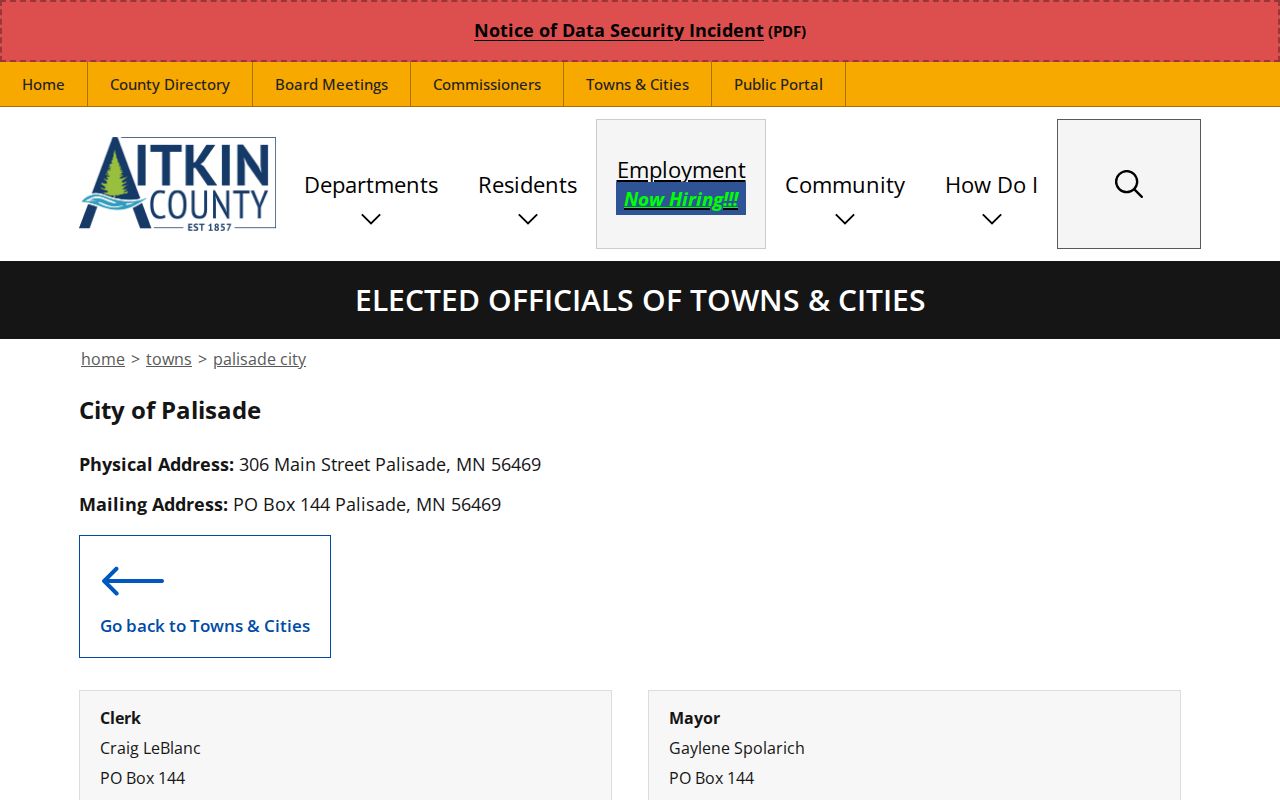
Those details cover Palisade city business only, so keep them apart from the Aitkin County court and sheriff contacts.
Chapter 13 Requests for Palisade Warrant Records
Not every Palisade record lives on a screen. Some warrant files sit in a drawer somewhere, and Minnesota law still gives you a way in. The Minnesota Government Data Practices Act lets any person ask an office for its public data, so a Palisade request simply goes to whoever keeps the records. Say up front whether you want to look at the file, get copies, or both. Describe what you are after as precisely as you can. Looking costs nothing. Copies may carry a charge, and once the bill passes $5 the county wants prepayment. If you ask in writing for summary data, Palisade or the county itself must answer on readiness and cost within 10 business days. One caution: request what the office already holds, not a fresh list built for you.
Where Palisade Warrants Fit With Aitkin County
Palisade runs on the same machinery as every other Aitkin County city. A citation filed there becomes a district court case. The court issues any warrant, the sheriff's office handles service, and the county attorney prosecutes.
Warrant flow: Palisade citation, district court case file, warrant issued by the court, sheriff service, court appearance.
Palisade is one piece of a countywide picture. The state case system and the other four cities appear on the Aitkin County warrant records home page.
Public Access to Palisade Warrant Records
Court files and city files in Palisade answer to different rules. The court file follows the Minnesota Rules of Public Access, which limit remote viewing. City data follows the state data practices law plus the city's own policy.
Key Rules:
The Minnesota Government Data Practices Act, Chapter 13 allows inspection of public data without stating a purpose.
Minnesota Rules of Public Access govern the court file and the limits on remote access.
Sealed and juvenile material stays out of public view, and a missing name result proves nothing.
A Palisade Notice Is Not a Warrant
In Palisade, a city mailing, a utility notice, and a court summons can land in the same week and look equally official. Only the court sends one of them. A real court document carries a case number, or a citation number that leads to one. A city notice has letterhead and no case number. When a Palisade paper lacks a case number, the clerk can tell you who sent it, and the court can say whether a case exists.